
Cross conveyor systems: powerful solutions for automated sawing and material handling processes
Increasing quantities, shorter delivery times, and a growing shortage of skilled workers pose specific challenges for metalworking companies in their daily operations. Manual transport routes often lead to bottlenecks, increased personnel costs, and safety risks, particularly in the sawing environment. Cross conveyors prove to be a technical solution for structuring the material flow, automating transport processes, and connecting sawing processes in an economical and reliable manner.
Areas of application in sawing technology
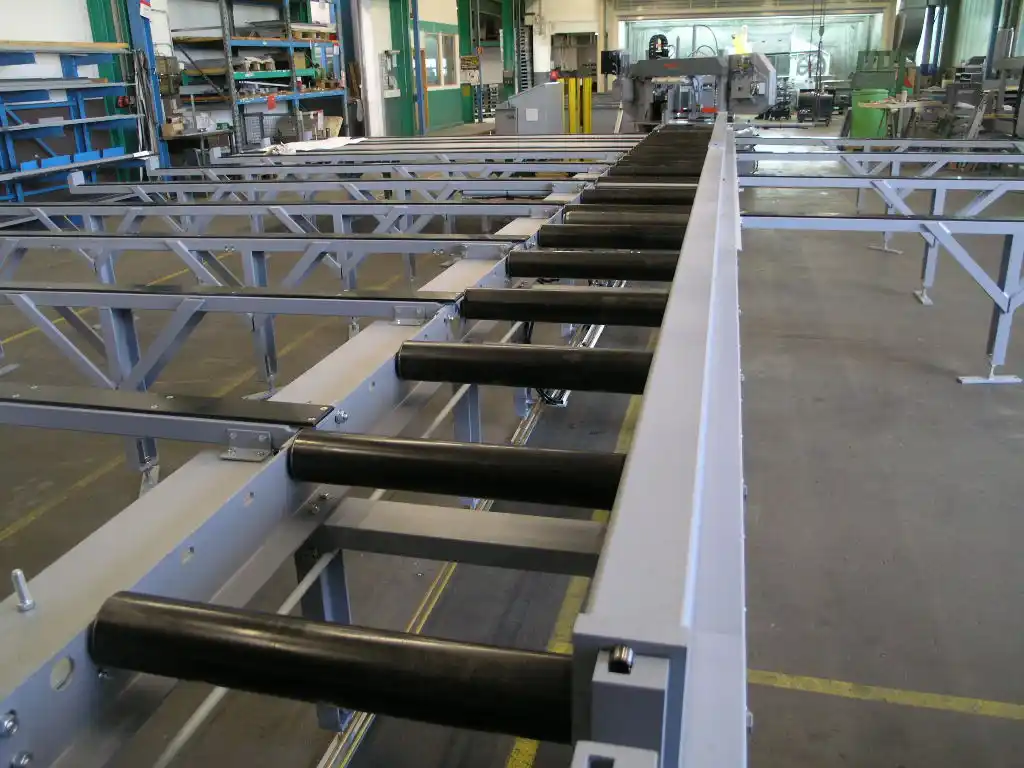
The use of cross conveyor technology is primarily focused on automated sawing processes. These systems are used both before and after the sawing process and perform defined transport tasks. Especially when combined with automated sawing systems, this creates a closed material flow that reduces downtime and reduces the workload for system operators.
Typical areas of application are:
- Material feed to the conveyor belt
- Material removal after cutting
Suitable materials and applications
Cross conveyors are designed for different material shapes and can be flexibly integrated into existing production environments. They are suitable for both light and heavy workpieces, supporting a wide range of applications. In practice, they are often used in steel trading, steel service centers, and in mechanical and metal engineering.
Typical materials are:
- Pipes
- Profile
- solid material
- Bundled workpieces in series production
Variants of cross conveyor systems
Depending on requirements and space conditions, different transport systems are available. These variants differ in design, function, and performance, but they all pursue a common goal: the safe and efficient cross-transport of material.
Common designs include chain conveyors for continuous transport, lift-and-carry conveyors, and cross conveyor tables for cycle-based processes. The selection depends on the weight of the material, cycle time, and desired degree of automation.
Contribution to productivity gains
The use of conveyor solutions for cross-transport of materials can significantly speed up work processes. Materials are available at the right place at the right time, minimizing waiting times. At the same time, the manual effort required for transport and positioning is reduced, which has a direct impact on productivity gains.
Another advantage is the reduced setup times. Since material is fed in and out automatically, saws can be prepared for new orders more quickly. This increases flexibility in day-to-day business and improves machine utilization.
Ergonomics and process reliability
In addition to economic aspects, ergonomics and process reliability are proving to be essential factors. Conveyor solutions for cross-transport of materials replace physically demanding lifting and carrying tasks with automated movements. This reduces the risk of injury and makes workplaces more ergonomic in the long term.
At the same time, controlled material transport ensures stable processes. Materials are defined, guided, and positioned, which minimizes sources of error and increases safety throughout the entire production area.
Modular solutions for flexible production layouts
A key advantage of modern cross conveyor units is their modular design. Individual modules can be flexibly combined and adapted to changing requirements. This results in modular solutions that can grow with production.
Adaptation to individual production layouts is particularly important here. Every production facility differs in terms of available space, material flow, and machine alignment. Cross conveyor technology can be configured accordingly and integrated into existing lines without fundamentally changing operations.
Automation as a strategic factor
Cross conveyors play an important role in the automation of sawing and material processes. They connect machines, buffer zones, and workstations to form a coordinated overall system. This simplifies planning, increases reproducibility, and supports customized material handling that is precisely tailored to the respective requirements.
In automated sawing systems in particular, transversely arranged conveyor systems form the link between individual process steps and contribute to the continuous optimization of material flow.
It won’t work without tailored advice
The selection and design of conveyor solutions for cross-transport of materials requires a precise analysis of existing manufacturing processes. Factors such as material types, quantities, cycle times, and space constraints must be taken into account. Sound advice from an expert such as MEBA is therefore essential for implementing solutions that are both technically and economically convincing.
Only when the system is precisely tailored to the respective requirements can the advantages be fully exploited and stable production processes be ensured in the long term.



Leave A Comment